How to Start a Daily Bible Habit Without the Guilt
· Erik Short
Quick answers
How do I start a daily Bible habit without guilt? Start absurdly small — five minutes, one passage, same time each day — and decide in advance that a missed day is a gap, not a verdict on you.
How long should I read the Bible each day as a beginner? Five to ten minutes is plenty; a habit you actually repeat beats an ambitious plan you abandon in February.
What should I read first? Pick one short book and stay in it — Mark, Philippians, or 1 John are all good first stops — instead of starting at Genesis 1 and stalling in Leviticus.
Why do I feel guilty when I miss a day? Usually because somewhere along the way you started measuring your standing with God by your consistency, which is a load Scripture never asked you to carry.
What's the fastest way to get back on track? Open the Bible today for two minutes. No catch-up plan, no apology. Today is the whole repair.
There's a particular feeling a lot of Christians know well. You bought the journal. You picked the plan. You read for nine days straight and it was genuinely good — and then there was a late night, a sick kid, a work trip, and now it's been three weeks and the app icon on your phone feels faintly accusing.
And here's the strange part: the guilt doesn't make you open it again. It makes you avoid it. The thing that was supposed to be rest became an exam you're failing.
If that's where you are, this is a guide for building a Bible habit without guilt as the engine. Not because guilt doesn't work — it works for about eleven days — but because it burns the very thing it's trying to build.
Why guilt is a terrible habit coach
Guilt is a loud motivator and a lousy one. Three reasons it keeps collapsing:
It makes the Bible a performance review. When reading is proof you're a serious Christian, every missed day becomes evidence against you. So you stop looking at the evidence. Avoidance isn't laziness — it's what people do when opening a thing means getting graded.
It inflates the entry cost. Guilt whispers that a real quiet time means thirty undistracted minutes with coffee and a journal and the right mood. So on a day when you have four minutes in a parking lot, you do nothing — because four minutes feels like cheating. Guilt would rather you do zero than something small.
It gets the gospel backwards. The whole claim of Christianity is that God's posture toward you was settled before you were consistent. Paul says it plainly in Romans 8:1 — there is now no condemnation for those who are in Christ Jesus. That's not a motivational slogan; it's the ground you're standing on. A Bible habit is how you enjoy that, not how you earn it.
Here's the reframe that changes everything: you're not reading to keep God happy with you. You're reading because He already is, and you want to know Him.
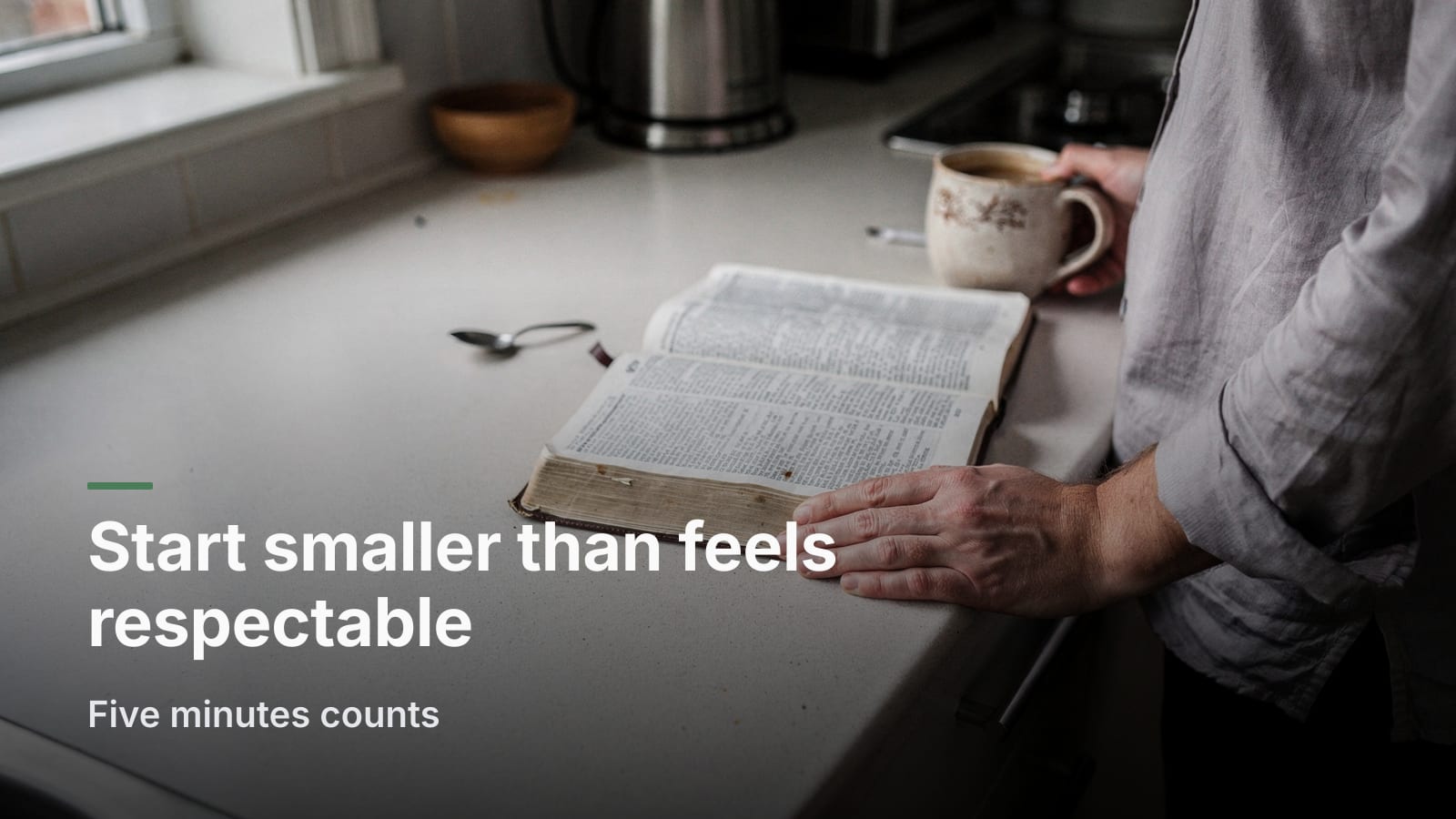
Start smaller than feels respectable
Most Bible habits die of ambition, not apathy.
The plan is too big, the time is too long, the goal is too vague — and the first hard week kills it. So aim lower than your pride wants.
Five minutes. Actually five.
Five minutes is enough to read a psalm slowly, or ten verses of Mark, or one paragraph of Philippians twice. It is not a watered-down version of a real habit; it is the version that survives a Tuesday. We've made the longer case for this in why five minutes of Bible reading is actually enough, but the short version is: the depth comes from repetition over months, not from length on any single day.
And five minutes has a hidden feature. It's too small to dread. You can't talk yourself out of five minutes with a straight face.
One book, not a whole-Bible plan
Year-long plans are wonderful for people who already have the habit. For people building it, they're a daily reminder of how far behind you are.
Instead, pick one short book and live there:
- Mark — fast, vivid, 16 chapters. Jesus from a dead sprint.
- Philippians — four chapters of joy written from a prison cell.
- 1 John — short, warm, repetitive in the best way.
- Psalms — not a book to finish; a book to visit. One a day, no order required.
Finishing something short builds more momentum than falling behind in something long.
Anchor it to something you already do
Don't schedule it by time of day — "I'll read at 6:30 a.m." is a promise your alarm clock has to keep. Anchor it to an existing action instead:
- After I pour coffee, I read.
- After I park at work, before I go in, I read.
- After I plug in my phone at night, I read.
- After the kids are down and the house goes quiet, I read.
The anchor does the remembering so your willpower doesn't have to.
Decide where the Bible physically lives
A habit has a location. Put the Bible where the anchor happens — on the kitchen counter, in the car door, on the nightstand on top of the remote. If it's in a drawer in another room, you've added three steps, and three steps is enough friction to end a fragile habit.
If you read on your phone, the same rule applies: the app goes on the home screen, first page, where your thumb already goes.
Build in the missed day before it happens
This is the part most guides skip, and it's the most important one.
You are going to miss days. Not might — will. Illness, travel, a newborn, a crisis, a plain old forgotten Thursday. If your plan has no room for that, your plan has an expiration date.
So decide now, while you're calm, what a missed day means. Write it down if you want:
A missed day means I missed a day. It does not mean I'm starting over, I'm a fraud, or God is disappointed. Tomorrow I open the Bible again.
That sentence is worth more than any reading plan. The people who build lasting habits aren't the ones who never miss — they're the ones with a short recovery time. One day off is a gap. Three weeks off usually started as one day off plus a week of avoiding the guilt.
The "never two in a row" rule
One miss is noise. Two misses is a pattern forming. So the only rule worth defending is: don't miss twice in a row. If you missed yesterday, today's reading can be two minutes and one verse — the point is simply to keep the chain of identity intact. You're still someone who reads.
Don't catch up
If you're eleven days behind in a plan, do not read eleven days of material. That's a punishment disguised as diligence, and nobody absorbs anything while doing penance.
Just read today's. Or better: throw out the schedule and read the next thing. The Bible isn't a debt you're servicing. We wrote more about this in missing a day doesn't erase your Bible habit, because it's the single belief that keeps most people from quitting entirely.
What to actually do in those five minutes
A blank page is its own kind of pressure. Here's a simple shape that fits in five minutes and doesn't require study skills:
- Ten seconds of quiet. Put the phone face down. Breathe. You're not clocking in.
- Read the passage slowly. Out loud if you're alone — it slows you down and catches things your eye skims.
- Ask one question: What does this show me about God? Not "what do I need to do differently" — that question turns every reading into a to-do list. Start with who He is.
- Say one sentence back to Him. "Thank you for that." "I don't understand this." "Help me believe it." That's prayer. It counts.
- Carry one phrase. Pick a few words from the passage and let them ride around in your head today.
That's it. No commentary, no journal required, no theological conclusion needed. Some days you'll feel something. Many days you won't — and the days you don't still form you. Faithfulness over time is not the same as feelings on a given morning.
When it's dry, boring, or you don't feel anything
You'll hit stretches where the Bible feels flat. Genealogies. Hard passages. Seasons of grief or burnout where nothing lands.
A few honest things about that:
- Dryness isn't failure. Showing up without a payoff is arguably the purest version of the habit. You're there for the Person, not the dopamine.
- Switch books, don't quit. Stuck in Numbers? Go to Luke. There's no rule that you must finish in order.
- Try a different sense. Listen to the audio while you drive. Read it out loud. Write a verse by hand. Same words, different door in.
- Shrink the goal. On rough weeks, one verse is the whole plan. Jesus didn't set a word count.
How long until it feels normal?
Honest answer: longer than a motivational post wants to admit, and shorter than you fear. Most people find that somewhere in the first couple of months, reading stops being a decision and starts being a default — the way brushing your teeth isn't a choice you weigh each night.
The variable isn't discipline. It's recovery speed. Keep the misses short and the sessions small, and the habit builds itself underneath you.
The quiet goal under all of this
The point was never the streak. A streak is just a side effect of showing up, and a number on a screen has never once made anyone love Jesus more.
The point is that there's a God who speaks, and you get five minutes with Him today, and tomorrow, and the day after that — and the days you miss don't change His face toward you one degree.
That's the whole invitation. It's lighter than you've been carrying.
Frequently asked questions
How do I start again after falling off?
Today. Not Monday, not the first of the month, not after you've found the perfect plan. Open to any short passage and read for two minutes. There's no re-entry process and no apology required — the restart is just reading today. If it helps, pick a brand-new short book so you're not staring at a half-finished plan.
Is it okay to read the Bible on my phone?
Yes. The phone is where you already are, and a Bible you actually open beats a leather one you admire on a shelf. The real issue is notifications, not format — turn them off, or use airplane mode for five minutes.
What if I don't understand what I'm reading?
Confusion is normal and permanent to some degree; nobody graduates. Jot the question down and keep going — most hard passages get clearer from context over weeks. A study Bible's footnotes or a trusted pastor are good next steps, but not understanding everything is never a reason to stop reading anything.
Should I read in the morning?
Only if mornings actually work for you. Morning reading is a common recommendation, not a biblical command. A consistent 9 p.m. habit is worth far more than an aspirational 5 a.m. one you keep sleeping through.
Does it count if I only read one verse?
Yes. One verse read attentively is a real meeting with God's word, and it keeps the habit alive on the days that are falling apart. Small days are what make long seasons possible.
How is this different from a reading plan I'd quit anyway?
Mostly in what happens when you miss. A plan that resets you to zero teaches you that failure is total; a habit built on grace assumes gaps and just asks you to come back. 5minutes.bible is built that way on purpose — short readings, and streaks that don't shame you for being human.
If you'd like a gentle place to start tomorrow, 5minutes.bible will be there — five minutes, no guilt.