Missing a Day Doesn't Erase Your Bible Habit
· Erik Short
Quick answers
What happens to my Bible habit if I miss a day? Nothing — the days you already read still happened, and the habit continues the moment you open Scripture again.
Why do I quit after breaking a streak? Because a zeroed counter feels like a verdict on you, and most people abandon a habit out of shame long before they lose interest.
How fast can I recover from a missed day? Immediately — one five-minute reading the next day restores the pattern, no catch-up required.
Does a daily Bible habit have to be perfectly consecutive to work? No. Consistency over months, not an unbroken chain, is what actually shapes you.
What's a healthier way to measure progress? Count days read over a stretch of time — like 24 out of the last 30 — instead of days since your last failure.
The miss isn't what kills it
Here's the part nobody says out loud: almost no one quits reading the Bible because they got bored with the Bible.
They quit because of what happened in their head the morning after a miss. The little counter said 0. Or the reading plan showed four days stacked up, waiting. And something in the chest went well, that's ruined, and the whole thing quietly got filed under "things I'm bad at."
That's the actual failure point. Not the missed Tuesday. The story you told yourself about the missed Tuesday.
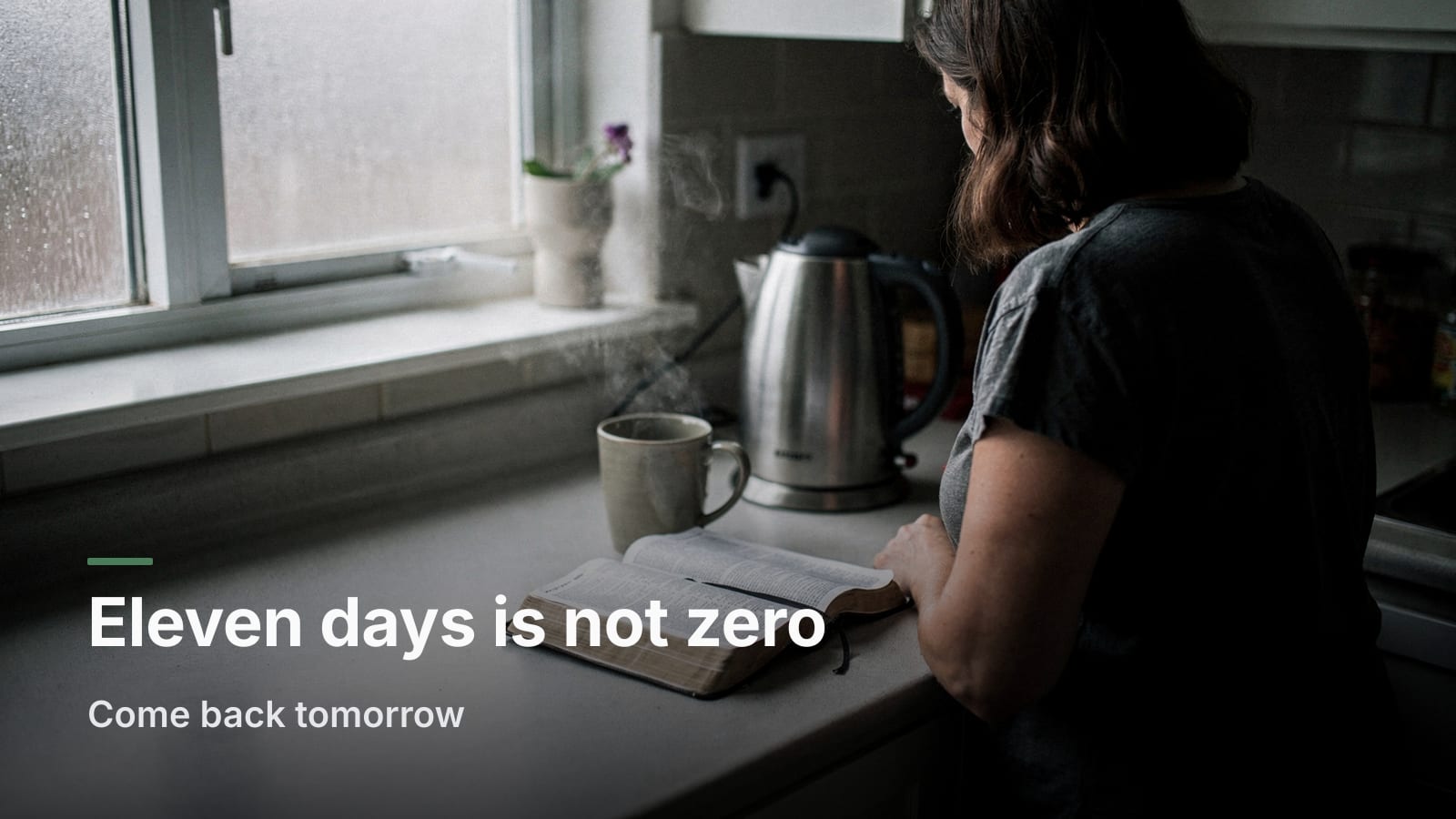
If you read for eleven days and then missed one, you read eleven days. That is eleven mornings you would not otherwise have had with Scripture. Eleven is not zero. It has never been zero. No counter resetting to 0 can reach backward and un-read those chapters.
Where the all-or-nothing wiring comes from
Some of it is just app design. A streak that resets is a clean, satisfying mechanic — it makes the number feel earned and the loss feel sharp. That sharpness is the point; it's what keeps you opening the app. It works beautifully for language drills and step counts.
It works less beautifully for the thing you're doing when you sit down with your Bible.
Because you're not grinding a counter up. You're showing up to be with God. And a system that punishes absence trains you to feel that your welcome depends on your attendance record. Nobody designs that on purpose. But that's what the mechanic teaches, day after day, in a place too deep for argument.
The other part of the wiring is older than any app. A lot of us learned somewhere along the way that our standing with God tracks with our performance for God — that a good week means He's pleased and a bad week means He's disappointed, arms folded, waiting for us to get serious. Nobody stated it that plainly. We just absorbed it. And then a Bible app with a broken streak becomes one more small scoreboard confirming what we already suspected about ourselves.
What Scripture actually says about your bad week
Here's what makes the all-or-nothing instinct so strange: it contradicts the thing you'd find if you actually opened the book.
Lamentations 3:22–23 says the Lord's mercies never come to an end; they are new every morning, and His faithfulness is great. New every morning — including the morning after the one you missed. The mercy isn't rationed based on yesterday's performance. It's fresh, and it's already there when you wake up.
Psalm 103 says He knows how we're made — that He remembers we are dust. It's not a scolding. It's a Father who is not surprised by your limits, who never had unrealistic expectations of you in the first place.
And Romans 8:1 says there is no condemnation for those who are in Christ Jesus. Not reduced condemnation for people with decent streaks. None.
So when a missed day makes you feel like you need to earn your way back into the room, that feeling has no support from the text you're trying to read. You can hold it up against Scripture and watch it fail to survive.
Consistency beats intensity — and consistency includes gaps
Think about anything you've genuinely kept up for years. Cooking dinner. Calling your mom. Flossing, if you're a better person than me. None of those are unbroken chains. They're patterns with holes in them. You do the thing most of the time, you skip sometimes, you come back without ceremony.
That's what a durable daily Bible habit looks like too. Not a perfect record — a strong default.
Here's the math nobody runs. Suppose you read four days a week for a year. That's roughly 200 days in Scripture. Now suppose you go all-in, read fourteen days perfectly, break the streak, feel awful, quit for two months, restart in a burst of resolve, and repeat that cycle four times a year. That's about 60 days. The "inconsistent" reader laps the intense one by a factor of three — and they're still going in January.
Intensity feels more spiritual. Consistency actually reads more Bible.
Five ways to make a miss survivable
The goal isn't to never miss. It's to make missing cost you one day instead of one month.
1. Decide what a miss means before you miss
Write it somewhere: If I miss a day, I read tomorrow. That's the whole plan. Making the decision while calm means you don't have to make it while ashamed — and shame is a terrible strategist.
2. Don't catch up
If you missed three days, do not read four days' worth today. Catch-up debt is how a reading plan turns into homework. Pick up where you are, today, and let the missed passages go unread. The Bible is not a syllabus you'll be tested on.
3. Make the minimum genuinely tiny
Five minutes. One psalm. Sometimes three verses and a breath. A habit you can do on your worst day is a habit that survives your worst week — and a low floor is what lets the streak be real rather than aspirational. If you've never set a floor that small, our piece on how five minutes a day is enough walks through why the size of the commitment matters more than the size of the intention.
4. Change the number you watch
Stop tracking "days since I last failed." Track "days read in the last 30." One is a shame meter. The other is information. Twenty-two out of thirty is a strong month, and it's a number a missed Tuesday can't take from you.
5. Anchor it to something that already happens
The kettle boiling. The car in the school pickup line. The kid finally asleep. Habits attached to existing moments recover faster after a gap, because the cue is still there tomorrow whether or not you showed up today.
The return is the habit
There's a pattern all through Scripture that's easy to miss if you're reading for rules. The prodigal's father runs toward him while he's still working on his apology. Peter denies Jesus three times and is asked three times if he loves Him, then handed a job. Jonah runs the opposite direction and gets the same commission again.
The Bible is not particularly interested in people with unblemished records. It's full of people who came back. That's not a loophole in the story — it is the story.
Which means the moment you open your Bible after a gap is not the moment you start over. It's the most characteristic moment of the whole Christian life. You're not rebuilding from zero. You're doing exactly the thing the book is about.
What we built, and why
This is the whole reason 5minutes.bible handles streaks the way it does. A missed day doesn't zero you out and it doesn't hand you a pile of catch-up reading. Your history stays your history, because it is. Miss Thursday, read Friday, and Friday counts as what it is — another day with God, not a restart.
Not because consistency doesn't matter. It matters a lot. But grace is what makes consistency possible in the first place. Guilt gets you about nine days and a resentment. Grace gets you years.
Frequently asked questions
What if I miss a day?
You read the next day. There's no penalty to pay and nothing to make up — the days you already read still count, and today counts too. If it helps, say it out loud: one missed day is one missed day, not a verdict.
Does a streak have to be consecutive to count?
Not in any way that matters. A consecutive streak is one way to measure a habit, and it's a fragile one. Days-read-out-of-thirty tells you far more about your actual life with Scripture, and it can absorb a hard week without collapsing.
What if I've missed weeks or months, not just a day?
The re-entry is the same size as any other day: five minutes. Don't start by auditing how long it's been or drafting a plan to make up the lost ground. Open a psalm, read it, close it. Long gaps feel like they require a big restart, but big restarts are exactly what broke last time.
Should I still use a plan that's dated, like a one-year Bible?
You can, but change one rule: when you miss, skip forward to today's date instead of reading from where you stopped. You'll finish the year having read most of the Bible rather than quitting in March under a mountain of February.
Isn't "grace" just an excuse to be lazy about Scripture?
It would be, if grace made you want to read less. In practice it does the opposite — people who aren't afraid of the scoreboard come back sooner and stay longer. Fear is a decent sprint coach and a terrible one for a marathon.
What if reading the Bible feels dry even when I do show up?
That's normal and it isn't a sign something's broken. Some mornings are just showing up. Keep the sessions short so a dry stretch never becomes a chore you're dreading, and switch books if you're stuck — moving to a psalm or a gospel often helps more than trying harder.
If you'd like a place to read for five minutes that won't punish you for the days you miss, 5minutes.bible is built for exactly that.