Why Five Minutes of Bible Reading Is Actually Enough
· Erik Short
Quick answers
Is five minutes a day enough time to read the Bible? Yes — five focused minutes is enough to read a psalm or a paragraph of a gospel and actually think about it, and it's short enough that you'll still do it on a bad day.
How much of the Bible can you read in five minutes? At a normal reading pace, roughly 500–700 words — about one psalm, one chapter of a gospel, or half a chapter of an epistle.
Is a short daily habit better than one long weekly session? For most people, yes: daily contact keeps Scripture in your working memory and makes the habit automatic, while a long session you skip does nothing at all.
What should I do in five minutes of Bible reading? Read a short passage slowly, pick one sentence that stands out, and pray that sentence back. That's it.
Does five minutes count as "real" devotional time? Time isn't the measure. Attention is. Five attentive minutes is more formative than thirty distracted ones.
There's a particular kind of shame that comes from owning seven Bibles and reading none of them.
You know the feeling. You've heard that serious Christians spend an hour in the Word. You've seen the reading plan that covers the whole Bible in a year, and you've started it — maybe more than once. You made it to Leviticus. Or you made it to January 11th. And somewhere in there, the plan stopped being a help and started being a ledger of everything you didn't do.
So here's the argument, plainly: five minutes a day is enough. Not enough for everything. Enough to be real, enough to be formative, and — this is the part that matters — enough to still be happening in six months.
The hour you never start beats nothing by exactly nothing
Do the math on your last twelve months.
If you read the Bible for an hour, four times, that's four hours. If you read it for five minutes a day and hit maybe 70% of days, that's about twenty-one hours. More than five times the Scripture, and none of the self-loathing.
The long session isn't wrong. An unhurried hour with an open Bible and a cup of coffee is a genuinely good thing, and if your life has room for it, take it. But most people don't have an hour. They have an hour in theory — a version of Tuesday that never arrives, sandwiched between a kid who wakes up early and a commute that runs long and a body that is simply tired.
A habit you can only do in ideal conditions is a habit that depends on ideal conditions. Five minutes doesn't. Five minutes survives the flu, the newborn, the deadline week, the travel, the grief. It's small enough to fit through the narrow door of a hard day, and hard days are most of them.
What five minutes actually holds
"Five minutes" sounds like a scrap. It isn't. Here's what fits:
- Psalm 23 takes about forty seconds to read aloud. You could read it three times and still have minutes left.
- A chapter of Mark runs a few minutes at a normal pace — the whole gospel in roughly six weeks of five-minute mornings.
- Philippians — all four chapters — is about a fifteen-minute read. Three days.
- The Sermon on the Mount (Matthew 5–7) is a week.
- One paragraph of Romans, read slowly twice, is a very full five minutes.
Read a chapter a day and you'll finish the New Testament in about nine months. Not because you sprinted. Because you showed up.
The scrap-sized feeling comes from comparing five minutes to some imagined ideal, not from comparing it to what's actually in front of you. A psalm is not a scrap. It's a psalm.
Depth is a function of attention, not duration
This is the part people get backwards. We assume depth is measured in minutes — that thirty minutes is six times deeper than five. But anyone who has spent thirty minutes with an open Bible and a phone buzzing beside them knows better.
Think about how Scripture itself talks about engaging with God's word. Psalm 1 describes the blessed person meditating on the law day and night — not in one long marathon block, but as something turned over across the ordinary hours. Deuteronomy 6 pictures words that are talked about when you sit at home, walk along the road, lie down, and get up. That's a pattern of frequent, woven-in contact, not a scheduled performance.
Five minutes done attentively gives you something to carry. You read one line in Isaiah about God holding your right hand, and it surfaces again at 2pm in a meeting you were dreading. That's the thing actually forming you — not the elapsed time on the clock.
Attention is the scarce resource. Five minutes is the honest amount of attention most of us can bring first thing in the morning, before the noise starts. Protect that instead of chasing volume.
Small is what makes it stick
There's a reason habit research keeps landing on the same principle: make the entry cost absurdly low. Not because small is the goal, but because small is what gets repeated, and repetition is what turns a decision into a default.
Every morning that you have to decide whether to read the Bible, you're spending willpower you'd rather spend elsewhere. Habits are what happen when the deciding stops. And you don't get there by having a heroic week. You get there by having a hundred unremarkable days.
Five minutes lowers the entry cost to almost nothing. There is no excuse that survives it. "I don't have time" doesn't survive five minutes. "I'm too tired" doesn't survive one psalm. And once the habit is automatic, you'll find something else happens naturally: some mornings you'll look up and it's been twenty minutes. Not because you forced it. Because you were interested.
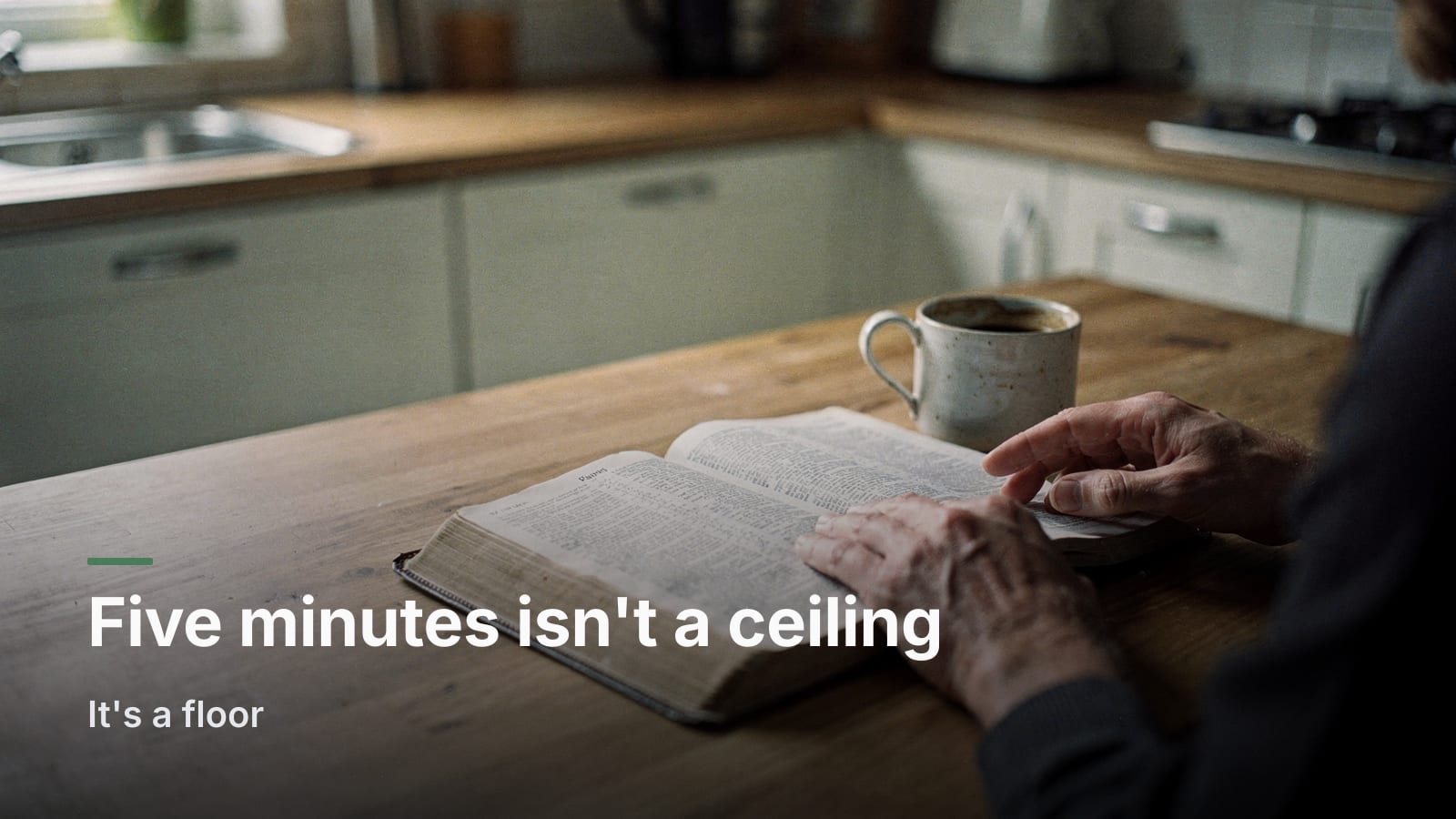
That's the secret nobody advertises. Five minutes isn't a ceiling. It's a floor. The floor is what keeps you in the room. What happens after that is between you and God.
What to actually do with the five minutes
A structure helps, because five minutes is short enough that fumbling costs you half of it. Here's a simple one:
- Pick the passage the night before. Or use a plan that picks for you. Decision-free starts are faster starts.
- Read it once, normally. Just get the shape of it.
- Read it again, slower. Look for one sentence — one — that lands.
- Say that sentence back to God. "You are my shepherd. I don't want for anything. Help me believe that today." Thirty seconds of prayer built straight out of what you just read.
- Stop. Don't guilt yourself into more. Stopping while you still want more is how you make sure tomorrow happens.
A few things that help it stick:
- Attach it to something you already do without thinking — the first coffee, the bus, the ten minutes after you drop the kids off. New habits ride on the back of old ones.
- Put the Bible where your hands already are. Physical Bible on the kitchen table, or the app on your home screen. Friction is the enemy.
- Read a book, not a shuffle. Random verses are fine; a book of the Bible in order is better. You get the argument, not just the aphorism.
- Don't start in Leviticus. Start in Mark, or Philippians, or the Psalms. Save the hard terrain for when the habit is load-bearing.
The days you miss
You will miss days. Not maybe — you will. A week will get away from you, and then there's that sour moment where you realize it's been nine days and you start doing the math on your own spiritual seriousness.
Here's the thing worth holding onto: the streak was never the point, and God's posture toward you on day nine is the same as it was on day one. There's no scoreboard being kept in heaven that you just fell behind on. We've written more about that in missing a day doesn't erase your Bible habit, because it's the single thing that derails more readers than busyness ever does.
The pattern that kills Bible habits isn't missing a day. It's the shame spiral that follows — the sense that you've broken something, that restarting means admitting failure, so it's easier to just not look at it. And that's where five minutes helps again. It's a low enough bar that coming back doesn't feel like a confession. It just feels like opening a book.
Enough is a real category
We've somehow absorbed the idea that there's no such thing as enough when it comes to spiritual disciplines — that whatever you did, more would have been holier. That's not grace. That's a treadmill with a cross painted on it.
Jesus didn't hand out reading quotas. He fed five thousand people with five loaves and it was enough — there were even leftovers. Small things placed in God's hands have a long history of being sufficient.
Five minutes a day with an open Bible, most days, for years, is not a compromise. It's a life shaped by Scripture. It's slower than the sprint and it outlasts it by decades.
Start there. Stay there as long as you like. And if it grows, let it grow on its own.
Frequently asked questions
Is five minutes too short to matter?
No. Five minutes gets you a full psalm or a gospel chapter with time to think, and daily contact with Scripture shapes you far more than an occasional long session. The danger isn't that five minutes is too short — it's that aiming for an hour means you read nothing at all.
Should I eventually work up to longer readings?
Only if you want to. Many people naturally drift longer once the habit stops requiring effort, and that's great. But treating five minutes as a beginner stage you should graduate from turns it back into a performance metric. Keep the floor, let the ceiling take care of itself.
Is it better to read in the morning or at night?
Whichever one you'll actually do. Mornings win for most people because fewer things have gone wrong yet, but a consistent 9pm reading beats an inconsistent 6am one every time. Pick the slot with the fewest competing demands.
What if I read the passage and feel nothing?
That happens, often, and it isn't a failure. Some days you're planting and some days you're harvesting. Read it anyway, note the one line that's at least interesting, and move on — faithfulness over a month looks nothing like any single day inside it.
Do I need a reading plan, or can I just pick something?
A plan mostly saves you the thirty seconds of deciding, which matters more than it sounds. If you'd rather choose your own, just commit to one book at a time and read it straight through rather than hopping around.
If a five-minute rhythm sounds like something you'd actually keep, 5minutes.bible was built for exactly that — and it won't make you feel bad about the days you miss.